
“I can’t wake up and not be a black woman…I can’t walk into a room and not be a black woman….On the bus, on the Tube, at work, in the cafeteria. Loud, brash, sassy, angry, mouthy, confrontational, b*tchy.…..Usual descriptors.”
—Candice Carty-Williams, Queenie 2019
*NOTE: This is a semi-spoilery review.
I hope you read that quote. Now you have just a little taste of what the implications are when it means that everything is almost always our fault, and that us black girls are always to know our place.
Book Review: I’m not going to lie, to be blatantly honest, the first half of this book did not hold my interest whatsoever. I was so close to not finishing it after the first few chapters. See, when we first meet the main character Queenie we find out that she is 25, lives in London (Brixton), a journalist, has a decent friend circle; but is having women health issues and has to move out of the flat she shared with her boyfriend Tom who she just recently went on a “break” with. Tom is white. Keep that in mind. Did I feel bad for Queenie? Yeah sure. Did I want to know what would happen to her and Tom’s relationship (although I mentally kept telling sis to MOVE ON!)? Of course. I needed another form of this book to help me with the reading, so I plugged into the audiobook as well. That helped a lot! Although there were different terms used or a few sentences missing here and there (maybe that’s the UK edition I’m not sure). Also, shoutout to Shvorne Marks for narrating it perfectly!! Anyway, despite the slow pace and rocky start in the beginning this was a book I felt I needed to finish. So I did just that.
The peak of this book is what gives it it’s five star excellence!
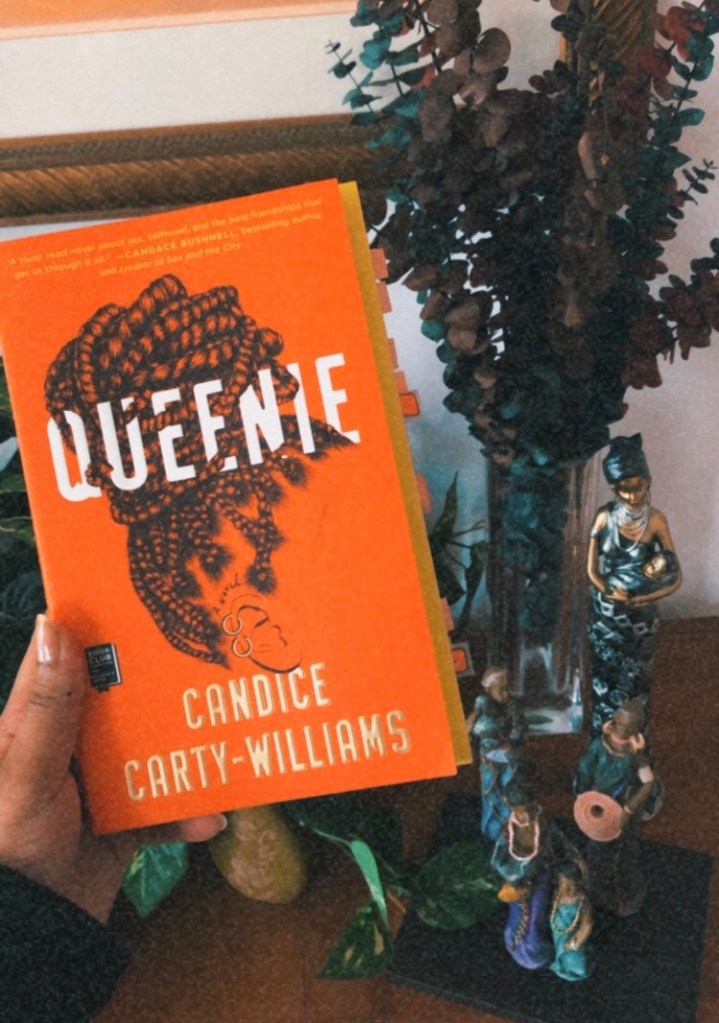
Once I got to chapter 12 (or around that part of the book) I realized that Queenie’s life was hitting the fan, hard. Having to find somewhere else to stay, the number of guys she meets on a dating app and simply sleeps with to cope for losing Tom (codependency in romantic relationships is a b*tch), the number of clinic visits she goes to, jeopardizing her job too many times, having to deal with her Jamaican British family, and friends, and them having to deal with her. But overall, her having to deal with herself. It’s like wake-up call after wake-up call after wake-up call.
I loved the flashbacks she has of moments she remembers from when she dated Tom, but as I think about them I realized they were moments that showed the downside (don’t get me started on his funny racists family) of their interracial relationship. I loved that she mends the relationship with her mother. I loved the relationship she had with her girl-friends. I loved that despite her never ending downward spiral she was able to stable her self in the end. She was finding a new Queenie. In all, Queenie was written to give readers a fresh story of a young black woman who is lost and flawed and, after handling things her way, finally gives in to the nature of needing help.
Now I want to discuss three prominent topics I appreciated the author incorporating into her novel.
#1. The Demeanor/Appeal of a Black Woman.
- As you read from the quote at the very top, the words in italics are adjectives that are used to describe and tie negative connotations to black women. I would also like to add how we’re “aggressive” or we “like to attack people” in certain situations. For some odd reason, when black women present themselves as free and outspoken, everyone starts b*tching.
- I really wish we could get over this “angry black woman” idea that some how makes us violent. We never say “Oh there she goes being a angry white woman.” She’s just simply angry.
- Don’t forget about the comments people make about us when they think they’re being nice: oh you’re so well-spoken, surprisingly intelligent, exotic, sexy, etc. That’s the equivalent of the Oreo saying: black on the outside, white on the inside.
- By the way, you’ll never win over a black girl if you say she looks and tastes like chocolate (especially if you’re not black).
#3. Sex Life
- I don’t care what statistics say, asking a black woman if she used protection when having sex is already uncomfortable. And when they say No, you should follow up and ask them if their partner was from….Africa. See, the idea is if someone were to have unprotected sex with someone from Africa they have a “higher risk of HIV.” Absurd.
- What we should be talking about is how casual sex can be one of the most toxic practices women do when they need to fill a void, or release some built up tension because life is sh*t at the moment.
- On the other hand, I do agree with Darcy in the book when she stated “Women should be free to have sex on date one, two, fifteen, without being judged or cast aside, but sadly, men aren’t as evolved as women.”
#2. Black Women (Black People) & Mental Health.
- I need the idea that “Black woman are supposed to be strong.” deaded RIGHT NOW!
- What got under my skin about this topic was how Queenie’s grandmother was not supportive of her going to therapy. She would rather tell Queenie her stories about how much pain she went through when she was her age. To top it all off she told Queenie that she would shame the whole family if she went.
- This is a problem in many black homes. I’m sure some of you might have heard “Black people don’t have mental health problems.” “Black people don’t need therapy.” “Black people don’t get depressed or have anxiety.” “It’s all taboo.” What does the color of your skin have to do with you being a human being that needs help!?
- It’s upsetting to be told “You’re fine. Just remember perseverance and resilience and you’ll be fine.”
- Despite what her grandmother said, Queenie does receive counseling and everyone is in support of it; even her grandmother who eventually sees that’s it’s helping.
- Note: Those who deal with mental health issues, you should never have to feel like you are a burden to someone. Know that you matter and you are not a burden for having burdens.
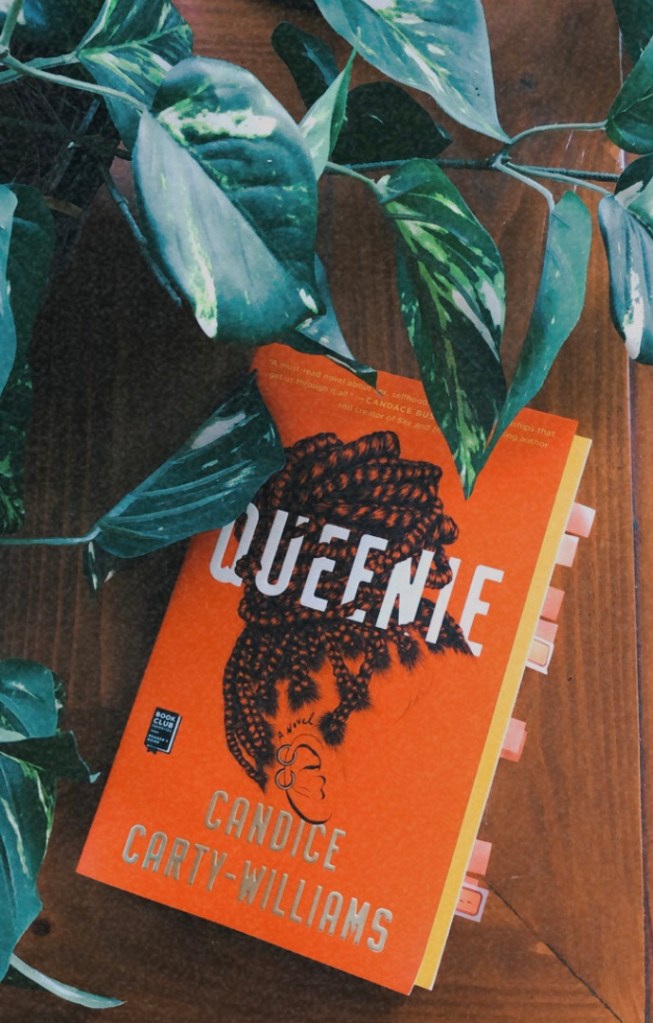
Lastly, I would just like to mention how the author continuously mentioned the Black Lives Matter movement! She dedicated a whole chapter on the matter (Chapter 16) to make sure that her readers FULLY understands what the movement is about, and how it’s just not something that affects black people in the United States but in so many other countries as well. Once of the characters makes a statement saying:
“The system is against us…..You cannot, you must not, brutalize the black body, but that is what we are seeing. It is all we are seeing. That is the message given. And it is traumatizing. Our people continue to suffer. The trauma is too heavy for us to bear…….”Black Lives Matter does not diminish any lives other than ours. That’s not what it’s about. What we’re saying right now is that we are the ones who are suffering.”
Kyazike | —Candice Carty-Williams, Queenie 2019
I also love chapter 27 when Queenie gets into a two hour argument about the matter with a neo-Nazi who was simply playing “devil’s advocate”. But just know she puts that bald man in his place.
Okay, this is lastly, I just want to say congratulations to the author Candice Carty-Williams on Queenie for being the first Black Author…..first Black Woman to win Book of the Year 2020 in the United Kingdom.
What a debut!
P.S. PROTECT BLACK WOMEN!

 Natalie's Nook
Leave a comment